P
Prontia
MATHS
Back to topic page
GCSELearning PackNumberFractions

Fractions Learning Pack

GCSE explanations, worked examples and practice for Fractions, covering Fractions meaning, Fractions representations, Fractions methods.

Resource

Work through the content for this resource.

Learning Pack

Fractions

What you will learn

  • Understand fractions as parts of a whole, positions on a number line and division
  • Use equivalent fractions to compare, simplify and calculate accurately
  • Solve fluency and problem-solving questions involving fractions

Before you start

  • Know times tables and common factors
  • Understand numerator and denominator
  • Use multiplication and division accurately
  • Recognise halves, quarters, fifths, tenths and hundredths

A fraction compares a part with a whole. The denominator tells you how many equal parts the whole is split into, and the numerator tells you how many of those parts are being used.

1. Fractions of real objects

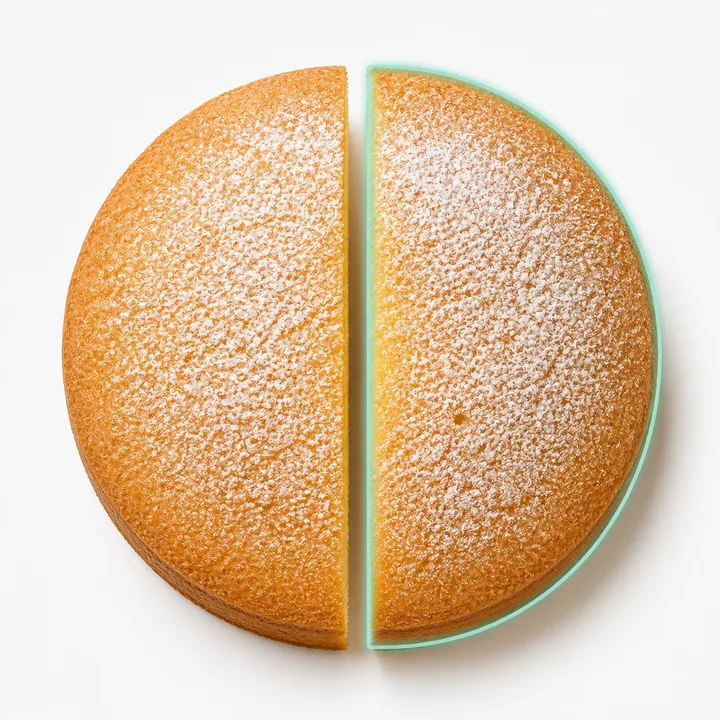
Fractions often start with real objects. If a cake is cut into 2 equal pieces, one piece is 12. If a pizza is cut into 3 equal slices, one slice is 13.

  • The pieces must be equal size
  • 12 means 1 out of 2 equal parts
  • 13 means 1 out of 3 equal parts
A round cake cut into two equal halves with one half highlighted

12 of the cake is shaded

A pizza cut into three equal slices with one third highlighted

13 of the pizza is shaded

2. What a fraction represents

Start by seeing the whole as equal parts. In 35, the whole is split into 5 equal parts and 3 parts are selected.

  • The denominator names the number of equal parts
  • The numerator counts how many parts are selected
  • The parts must be equal size

35 of the whole is shaded

Numerator: 3 selected parts
Denominator: 5 equal parts

3. Equivalent fractions

Equivalent fractions look different but have the same value. You make them by multiplying or dividing the numerator and denominator by the same number.

  • 12, 24 and 48 cover the same amount
  • The value stays the same because the whole has been split into smaller equal parts
  • Equivalent fractions help with comparing, adding and subtracting

12

24

48

4. Fractions on a number line

A fraction is also a position between whole numbers. To place 34, split the distance from 0 to 1 into 4 equal jumps, then count 3 jumps.

  • The denominator tells you how many equal intervals to make
  • The numerator tells you how many intervals to count along
  • This helps with ordering fractions
01/42/43/413/4

5. Adding fractions

Fractions can only be added directly when the parts are the same size. If the denominators are different, rewrite one or both fractions using a common denominator.

  • 14 is the same as 28
  • 28 + 38 = 58
  • Only add the numerators once the denominators match

14

14 = 28

38

28 + 38 = 58

Key vocabulary

  • numerator
  • denominator
  • equivalent
  • simplify
  • improper fraction
  • mixed number
  • common denominator
  • reciprocal

Key facts and methods

  • Equivalent fractions have the same value but use different numerators and denominators
  • To simplify a fraction, divide the numerator and denominator by the same common factor
  • To add or subtract fractions, use a common denominator first
  • To multiply fractions, multiply the numerators and multiply the denominators
  • To divide by a fraction, multiply by its reciprocal
  • A fraction of an amount can be found by dividing by the denominator, then multiplying by the numerator

Learning route

  • Decide whether the question is asking you to compare, simplify, calculate or find a fraction of an amount
  • Check whether the denominators are already the same
  • Use equivalent fractions when the denominators need to match
  • Simplify the final answer where possible
  • Check whether the answer should be written as a fraction, mixed number or whole number

Worked example 1

Simplify 1824

1. Find a common factor of 18 and 24

2. Both numbers divide by 6

3. 1824 = 34

Answer: 34

Worked example 2

Calculate 23 + 512

1. Use 12 as a common denominator

2. 23 = 812

3. 812 + 512 = 1312

4. 1312 = 1 112

Answer: 1 112

Worked example 3

Find 35 of 40

1. Divide 40 by the denominator: 40 / 5 = 8

2. Multiply by the numerator: 8 times 3 = 24

3. So 35 of 40 is 24

Answer: 24

Guided practice

  • Write 35 as an equivalent fraction with denominator 20
  • Simplify 1435
  • Calculate 14 + 38
  • Find 27 of 63

Independent practice

  • Put 56, 34 and 712 in ascending order
  • Calculate 45 - 13
  • Calculate 38 × 49
  • Calculate 56 / 23

Mixed practice

  • A recipe uses 34 kg of flour. Sam makes 23 of the recipe. How much flour does Sam use
  • A tank is 58 full. 12 litres are added and it becomes 78 full. Find the capacity of the tank
  • A student says 23 + 14 = 37. Explain the mistake and give the correct answer

Common misconceptions

  • Adding denominators as well as numerators
  • Simplifying by subtracting instead of dividing
  • Forgetting to convert mixed numbers before multiplying or dividing
  • Using a common denominator for multiplication when it is not needed
  • Leaving an answer unsimplified when the question asks for simplest form

Check understanding

  • Why does multiplying the numerator and denominator by the same number keep the value the same
  • When do fractions need a common denominator
  • What is the reciprocal of 35
  • How can you check that 1824 and 34 are equivalent
  • Which operation is needed to find 23 of 45